
There is a moment every September when parts of British Columbia seem to catch fire.
Not literally. Instead, high on mountain slopes where summer is already retreating, stands of larch begin changing from soft green to luminous yellow. Against dark spruce and fir, grey rock and the first dusting of snow, the effect can be startling: entire hillsides appear lit from within.
Then, almost as quickly as it arrived, the show is over.
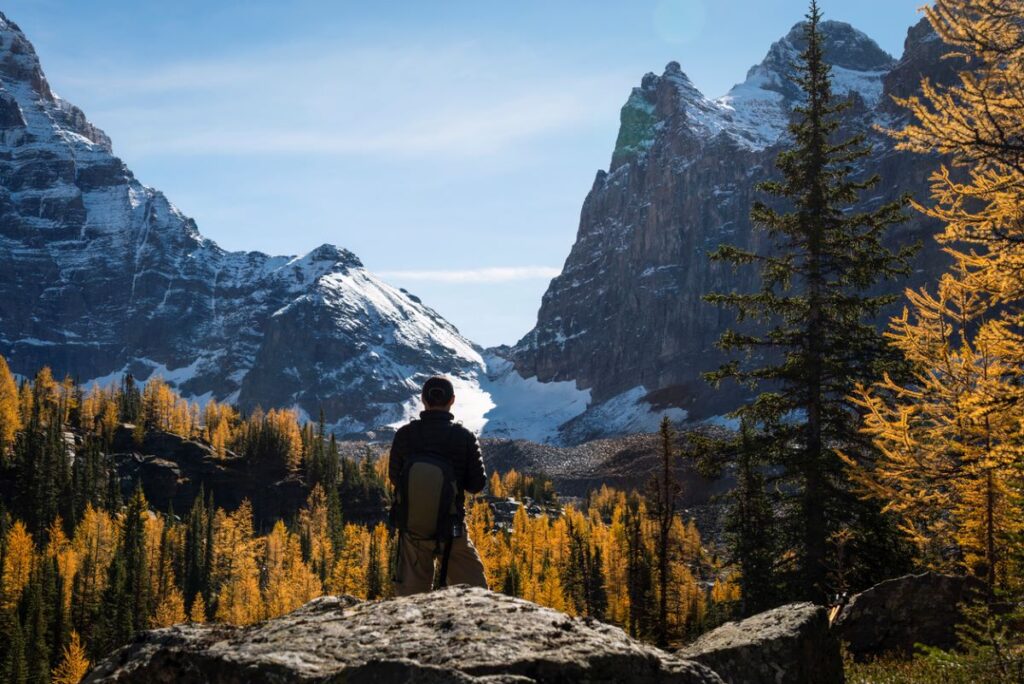 Photo by iStock
Unlike most of the conifers surrounding them, larches are deciduous. They grow needles and cones, but each autumn their needles change colour and fall, leaving bare branches through winter. It makes larch season one of BC’s great seasonal spectacles – and one that rewards travellers who understand that timing is everything.
For hikers and photographers, that narrow window has become an autumn ritual. But you don’t necessarily need to undertake a major alpine expedition to experience it. From high-country groves in Manning and Yoho to easy trails and scenic drives around Kimberley, there are ways to chase the gold at almost every level of adventure.
Why Does A Conifer Turn Yellow?
Larches look like evergreens for most of the year, which makes their transformation seem almost rebellious.
During spring and summer, chlorophyll gives the needles their green colour and plays a central role in photosynthesis. As days shorten and the tree prepares for dormancy, chlorophyll breaks down and nutrients are moved out of the foliage for storage elsewhere in the plant. With the green pigment disappearing, yellow pigments that had been present all along become visible. Eventually, the needles drop.
For alpine larch, the strategy comes with another advantage.
BC’s subalpine – or alpine – larch (Larix lyallii) lives in an environment few trees tolerate particularly well. Provincial forestry information places it primarily between about 1,800 and 2,300 metres, near the transition between subalpine forest and alpine tundra. It can withstand extraordinarily cold winters, and losing its needles helps reduce the winter moisture loss that can damage evergreen conifers when soils are frozen.
The result is a tree remarkably well suited to timberline: gnarled, slow-growing and capable of surviving for centuries in places that spend much of the year buried in snow. BC records indicate that alpine larches typically live up to 500 years, with some estimated at more than 1,000 years old.
And for a brief period each fall, they glow.
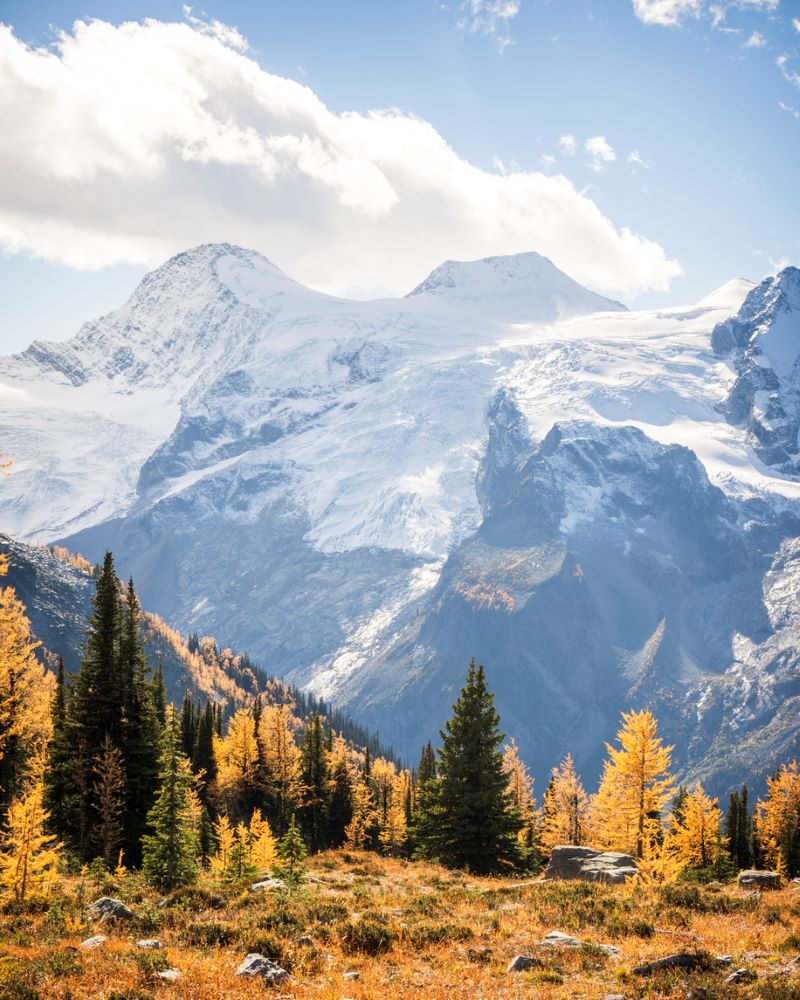 Photo by iStock
Not All BC Larches Are The Same
British Columbia actually has three native members of the larch genus: alpine larch, western larch and tamarack. For fall travellers in southern BC, however, the first two create most of the classic golden-larch experiences.
Alpine larch grows high in the mountains of southern British Columbia. Its habitat puts many of the best-known groves at the end of hiking trails and into country where September can feel distinctly like winter.
Western larch (Larix occidentalis), by contrast, generally grows lower. Natural Resources Canada places its Canadian range in southeastern BC and into Alberta, commonly at elevations between roughly 400 and 1,500 metres. It can reach 70 metres in height, towering over hikers rather than hunkering down at timberline.
That difference in elevation helps stretch the travel season.
High-elevation alpine larches typically provide the first sought-after display in late September, while lower western larch forests can carry autumn colour well into October. In the Kootenays, regional tourism organizations describe the broader larch season as running from late September and early October into later autumn, depending on elevation, weather and location.
In other words: if you miss the alpine peak, don’t necessarily put away the hiking boots.
Head downhill.
Frosty Mountain: The Classic Southern BC Larch Hike
One of the province’s best-known larch destinations lies surprisingly close to both the Lower Mainland and the Okanagan.
E.C. Manning Provincial Park sits in the Cascade Mountains, within about three hours of both regions. On the Frosty Mountain Trail, hikers climb toward Frosty Creek Campground at 1,850 metres. About half a kilometre beyond the campground, according to BC Parks, the trail enters a larch grove that continues for roughly 1.5 kilometres.
The appeal becomes obvious in autumn.
The trail rises out of darker forest into increasingly open mountain terrain, where golden trees stand beneath Frosty Mountain’s rocky slopes. On a clear September day, blue sky, yellow needles and distant ridgelines produce the kind of scene capable of turning a pleasant hike into a pilgrimage.
It is not, however, a casual stroll. Reaching Frosty Creek alone involves a strenuous seven-kilometre climb, and anyone continuing higher needs to be prepared for mountain conditions.
That matters especially during larch season. Autumn may be spectacular in the mountains, but it is not an extension of summer.
Lake O’Hara: Spectacular & Intentionally Difficult To Access
For perhaps the most famous combination of golden larch and turquoise mountain lakes in BC, there is Yoho National Park’s Lake O’Hara.
Here, larch forests are woven through a network of high-country trails. The Lake McArthur circuit climbs through larch forest, while the aptly named Big Larch Trail forms part of the route through the area. Parks Canada was reporting the Big Larch Trail in good condition as of Sept. 11, 2026, while reminding visitors to stay on trail because of fragile alpine vegetation.
The catch is access – and that’s deliberate.
Parks Canada limits access to Lake O’Hara to protect the sensitive alpine environment. In 2026, seats on the day-use shuttle were distributed through a random draw, and advance reservations are required for the campground. The shuttle operates through Oct. 4 this year, placing its final weeks squarely within autumn hiking season.
Travellers without a reservation shouldn’t assume they can simply drive up: the access road is closed to public vehicles. Hiking the road is possible, but at 11 kilometres each way before adding any alpine trails, it changes the outing considerably.
The restrictions are also a useful reminder that experiencing a place doesn’t always mean maximizing the number of people who can reach it. At Lake O’Hara, protecting the landscape is part of the experience.
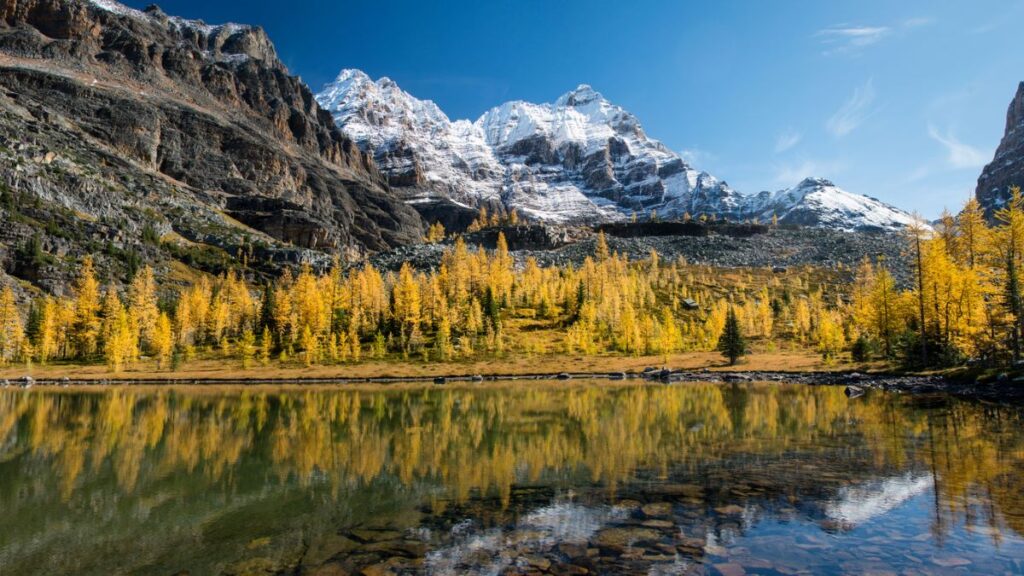 Photo by iStock
Go Deeper In Yoho – Or Make It An Overnight Trip
Lake O’Hara isn’t Yoho’s only larch country.
Goodsir Pass offers a considerably more ambitious option: a 25-kilometre one-way route from the Ottertail trailhead that climbs through forest into what Parks Canada describes as a larch-laden pass beneath the Goodsir Peaks. It can also connect with Kootenay National Park’s Rockwall route.
This is backpacking territory rather than casual leaf-peeping, and late-season conditions deserve respect. Parks Canada specifically warns that autumn snowfall can make higher portions of the Rockwall difficult by late September and October.
That unpredictability is part of the golden-larch window: the same cold nights and shortening season that transform the trees can turn a dry trail into an early-winter outing remarkably quickly.
Kimberley: Larch Country Without The Alpine Commitment
For travellers who would rather combine autumn colour with restaurants, accommodations and shorter outings, the East Kootenay offers an entirely different larch experience.
Kimberley sits amid extensive western larch country, allowing visitors to see autumn colour without climbing to timberline. Tourism Kimberley recommends the three-kilometre Centennial Trail at the Kimberley Nordic Centre as an all-level outing beneath mature larches; the local Nature Park and adjoining Horse Barn Valley Interpretive Forest offer numerous other walking and cycling possibilities close to town.
For a broader road trip, the Kootenay Rockies tourism region highlights the corridor around Kimberley, Cranbrook and Marysville for western larch colour. Here, autumn can be enjoyed as much from the road and valley trails as from the high country.
This is also where the difference between western and alpine larch becomes particularly useful to travellers. Spend a September day among high-elevation alpine trees, then return later in the season to see towering western larches glowing around the valleys.
An Easier Fall Outing Near Rossland
Golden-larch travel doesn’t have to involve a summit at all.
Nancy Greene Provincial Park, west of Castlegar, has a five-kilometre loop around the lake through mixed forest containing pine, spruce, fir and larch. BC Parks describes the trail as wide, hard-packed and easy, making it a far more accessible option for families or travellers looking for fall colour without committing an entire day to the backcountry.
That diversity is part of what makes BC’s larch season so appealing. It can mean standing among wind-shaped trees near timberline – or taking a relaxed lake walk beneath western larches with a thermos of coffee.
The Problem With A Two-Week Spectacle
A short natural event has an obvious consequence: everybody wants to see it at the same time.
That can concentrate hikers, photographers and vehicles into a handful of well-known destinations precisely when alpine ecosystems are most vulnerable. High-elevation soils are often thin, vegetation grows slowly and damage can take a long time to recover. BC’s own recreation guidance notes that alpine and subalpine ecosystems have short growing seasons and are particularly susceptible to disturbance.
The easiest way to reduce that impact is also the least glamorous: stay on the trail.
Don’t step into a meadow because the photograph is better from three metres to the left. Don’t create a shortcut around a muddy patch. Don’t spread out across fragile ground while waiting for someone to finish taking a photo.
BC Parks asks visitors to travel on durable surfaces, avoid disturbing plants and follow Leave No Trace principles; in developed areas, vehicles should also be left only in designated parking spaces.
And if a destination is overwhelmed, consider going somewhere else.
The trees don’t know which trail is famous on Instagram.
Go Prepared For Fall – Not Summer
Perhaps the biggest mistake in planning a larch trip is looking at a sunny forecast in the valley and forgetting where many of these trees grow.
By late September, darkness comes earlier, overnight temperatures at elevation can drop below freezing and snow is entirely possible. High routes may become icy or disappear under fresh snow even when conditions below remain pleasant.
Carry insulating layers, rain protection, food, water, navigation and a headlamp. Check current park advisories and trail conditions immediately before leaving rather than relying on a trip report from the previous weekend. In remote areas, remember that cell coverage may be limited or nonexistent.
And leave enough time to enjoy the reason you came.
Larch season does not reward rushing particularly well.
Catch It While It Lasts
The appeal of autumn larches is partly visual: there are few sights quite like brilliant yellow trees scattered across a grey mountain basin.
But their brevity is just as important.
For most of the year, alpine larches blend quietly into BC’s high country. Then shortening days trigger an ancient cycle. Chlorophyll disappears. Gold emerges. Needles fall. Winter closes in.
Within weeks, the trees that drew hikers from across the province are bare again.
Perhaps that is what makes the golden-larch window feel less like ordinary fall foliage and more like an event.
You have to know where to look.
You have to arrive at roughly the right moment.
And when you do, the mountains put on one remarkable show.