
At first glance, there’s nothing particularly unusual about a row of floating buoys in a quiet coastal inlet. They might mark a mooring, a fishing area or some other activity beneath the surface. But look a little closer, and you could be gazing at one of British Columbia’s many shellfish farms.
Unlike traditional farms, with their cultivated fields and orderly rows of crops, shellfish farms are often almost invisible. Some occupy stretches of beach that disappear beneath the incoming tide. Others extend into deeper water, where thousands of shellfish grow in suspended baskets, bags and nets.
Together, these operations produce oysters, mussels, scallops and clams for seafood markets and restaurants, drawing on the natural productivity of BC’s coastal waters.
And while shellfish farming might seem like a relatively modern enterprise, people have been cultivating and managing shellfish along this coastline for thousands of years.
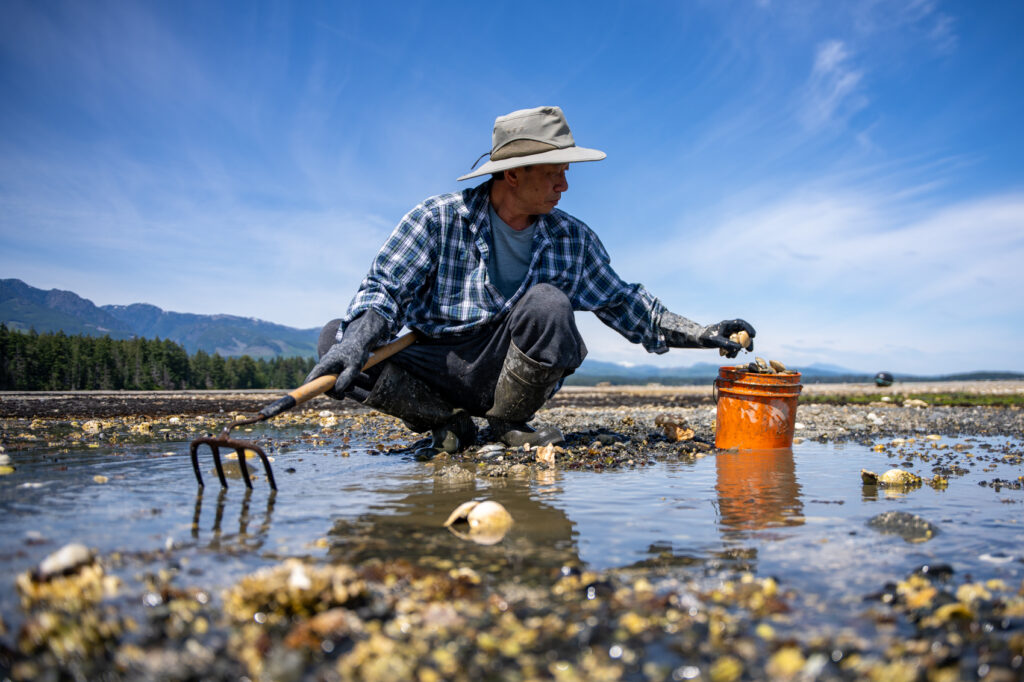 Photo By Fanny Bay Oysters
Farming With The Tides
Shellfish aquaculture works a little differently from agriculture on land. Rather than planting seeds in soil and supplying fertilizer, farmers raise young shellfish in carefully selected marine environments where food arrives naturally with the tides.
Oysters, mussels, scallops and clams are all bivalves, meaning they have two hinged shells. They’re also filter feeders, drawing seawater through their bodies and extracting tiny plankton and other suspended food particles.
This natural feeding process means farmers generally don’t need to provide manufactured feed. Instead, their work revolves around selecting suitable growing locations, protecting young shellfish, maintaining equipment and monitoring the conditions that influence growth.
The process typically begins with microscopic larvae, either collected from natural spawning or produced in specialized hatcheries. As the larvae develop and settle, they become juvenile shellfish known as seed or spat.
From there, the growing methods vary considerably depending on the species.
Oysters: From Beach Beds To Floating Baskets
Oysters are the backbone of BC’s shellfish aquaculture industry, with Pacific oysters accounting for the largest share of production.
Despite their name, Pacific oysters aren’t native to British Columbia. They were introduced from Japan in the early 20th century, with commercial cultivation dating back to 1912.
Today, they’re raised using several different methods.
On intertidal farms, young oysters may be placed directly on suitable beach beds, where they’re exposed to the air at low tide and submerged when the water returns. Other growers use mesh bags supported on racks, keeping oysters off the seabed while allowing water to circulate around them.
In deeper water, oysters can be grown in suspended trays, cages or bags attached to floating structures.
These systems allow farmers to control growing conditions more closely, but they also require regular maintenance. Oysters may be sorted according to size, cleaned of organisms growing on their shells and moved between growing areas as they develop.
Some floating-bag systems allow wave action to gently tumble the oysters, helping shape their shells and produce a more uniform product.
The journey from tiny spat to a marketable oyster can take several years, depending on the growing conditions, species and desired size.
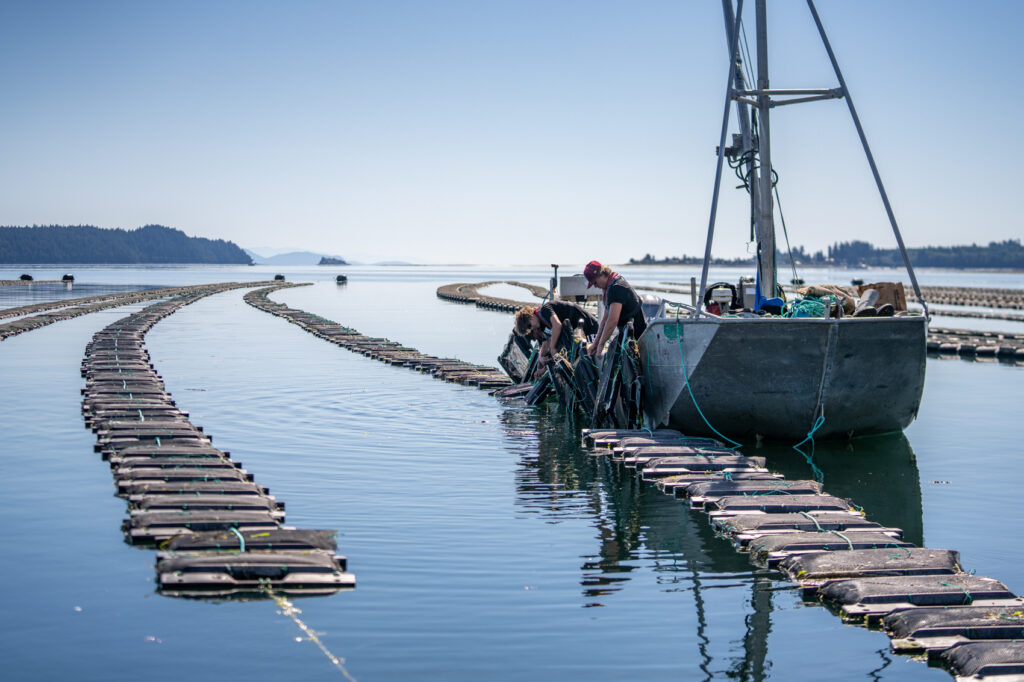 Photo By Fanny Bay Oysters
Mussels: Growing On Underwater Ropes
If oysters are the most familiar members of BC’s shellfish farming industry, mussels might be among the easiest to overlook.
Mussel farms commonly use suspended growing systems, with long ropes hanging vertically beneath floating lines or rafts.
Young mussels naturally attach themselves to surfaces using strong, thread-like fibres called byssal threads. Farmers take advantage of this behaviour by encouraging juvenile mussels to settle and grow on suspended ropes or within tubular mesh sleeves known as socks.
As the mussels mature, they form dense clusters along the ropes, feeding on plankton carried past by the currents.
Keeping them suspended above the seabed helps protect them from some bottom-dwelling predators and provides access to circulating water.
When the mussels reach marketable size, farmers lift the ropes from the water and remove the clusters for cleaning, grading and processing.
From the surface, a mussel farm might appear to be little more than a series of evenly spaced floats. Beneath them, however, an entire crop hangs in the water column.
Scallops: A Different Kind Of Shellfish Farming
Scallops are particularly interesting because, unlike oysters and mussels, many species are capable of swimming.
By rapidly opening and closing their shells, scallops can propel themselves through the water in short bursts, usually to escape predators.
That mobility creates different challenges for farmers.
In BC, commercially cultivated scallops are generally raised in suspended systems, often using specialized mesh containers known as lantern nets. These have several stacked compartments, allowing scallops to grow while remaining contained and exposed to circulating seawater.
Farmers periodically inspect, clean and sort the scallops, making sure they have enough room as they mature.
Scallop farming represents a much smaller portion of BC’s shellfish aquaculture industry than oyster production, but it demonstrates how cultivation methods can be adapted to the needs of individual species.
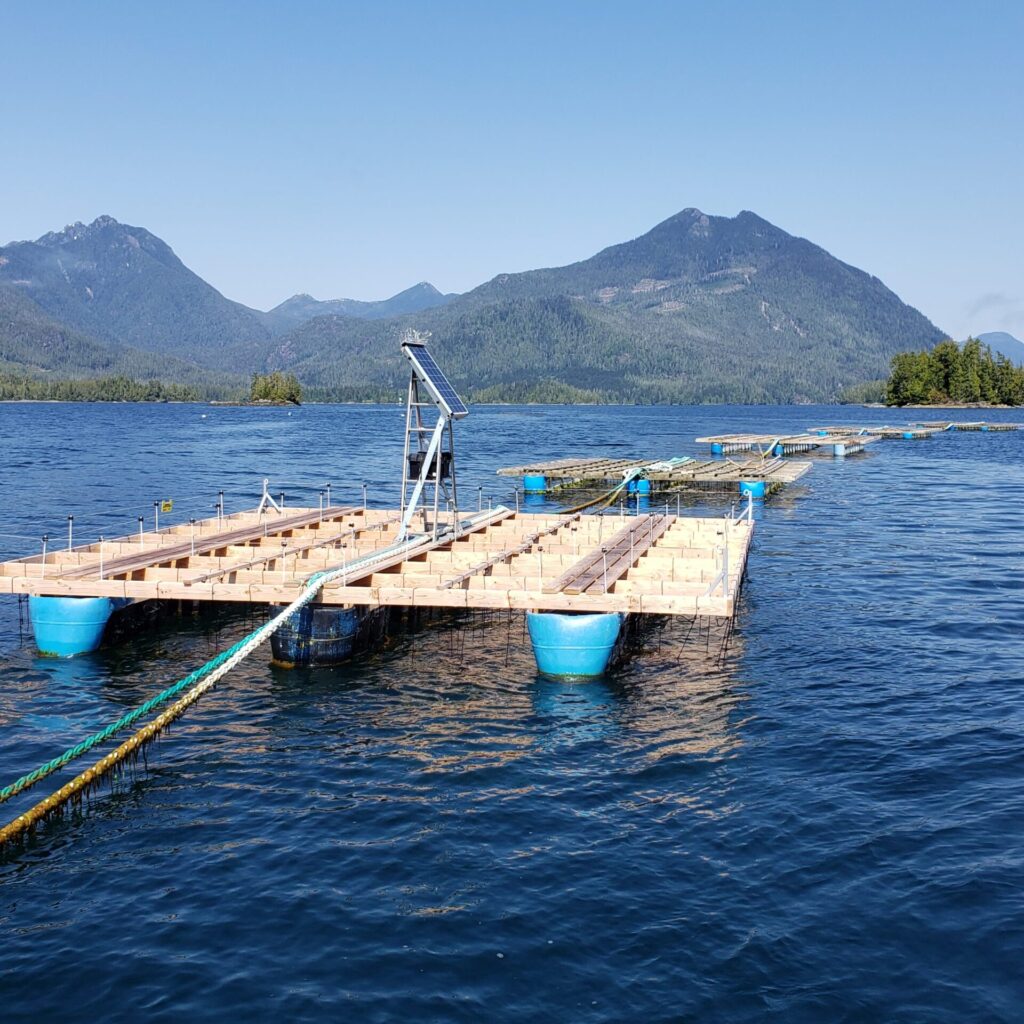 Photo By BC Shellfish Growers Association
Clams: A Crop Beneath Your Feet
Clam farming is perhaps the most inconspicuous of all.
Walk across a sandy or gravelly beach at low tide, and you might unknowingly be standing above thousands of cultivated clams.
Manila clams are among the principal species grown commercially in British Columbia. Like Pacific oysters, they were introduced from Asia, arriving unintentionally with imported oyster seed during the early 20th century.
Clam cultivation typically begins when farmers distribute juvenile clams across suitable intertidal areas. The young clams burrow into the sand or gravel, where they remain as they grow.
Farmers may install protective netting over newly seeded areas to reduce losses to predators such as crabs and sea stars.
Unlike suspended shellfish operations, clam farms rely heavily on the natural characteristics of the beach itself. Sediment composition, water movement, tidal exposure and food availability all play important roles.
When the clams reach a suitable size, they’re generally harvested by hand using rakes or other specialized tools.
To someone unfamiliar with the industry, the beach might look entirely natural. Apart from occasional netting, boundary markers or signs, there may be little indication that it’s a working farm.
An Ancient Tradition Of Coastal Cultivation
Although modern shellfish farming relies on hatcheries, suspended nets and specialized equipment, the practice of managing shellfish habitat has much deeper roots in British Columbia.
For thousands of years, coastal First Nations have cultivated and harvested shellfish, developing detailed knowledge of local beaches, tides and marine ecosystems.
One particularly remarkable example is the clam garden.
These traditional systems involve constructing low rock walls along the lower portions of beaches, creating or enlarging gently sloping intertidal terraces. Over time, sediment accumulates behind the walls, increasing the amount of suitable habitat for clams.
Clam gardens can improve growing conditions and increase shellfish productivity, demonstrating a sophisticated understanding of coastal ecology long before the development of modern aquaculture equipment.
Today, several First Nations are working to restore and maintain clam gardens, reconnecting cultural practices with marine stewardship and food harvesting.
These ancient coastal landscapes offer an important reminder that shellfish cultivation is not a new idea imported to BC’s shores. It has been part of life here for generations beyond counting.
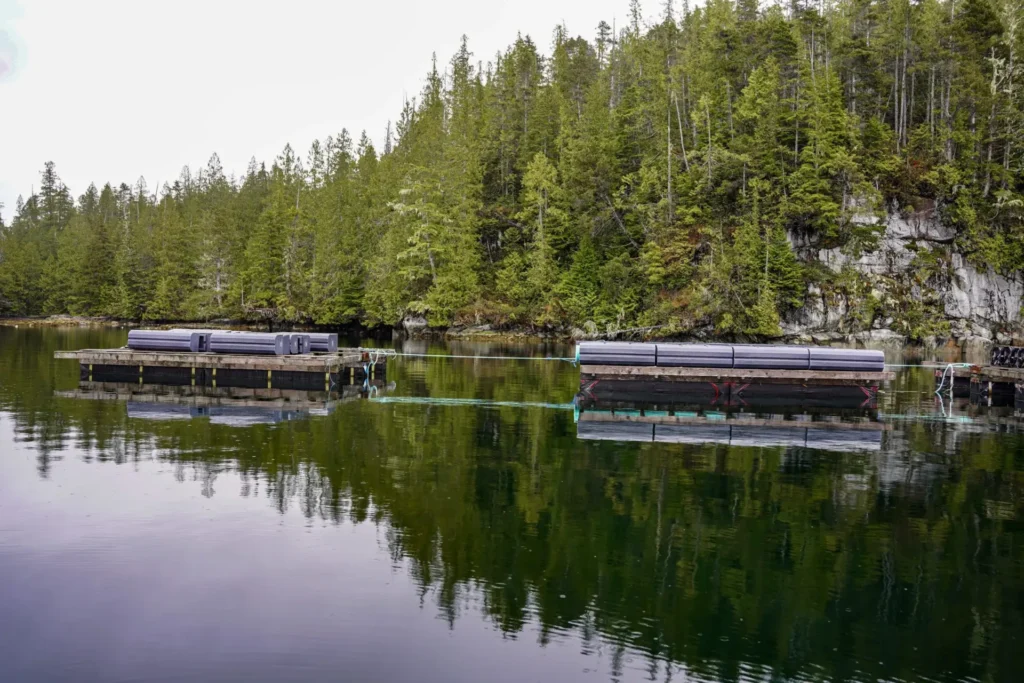 Photo By K’awat’si Shellfish
A Working Coastline
Shellfish farms can be found throughout coastal British Columbia, particularly around Vancouver Island, the Gulf Islands and parts of the Sunshine Coast.
Baynes Sound, between Vancouver Island and Denman Island, is especially well known for its productive shellfish-growing waters.
The sheltered inlets, extensive intertidal beaches and nutrient-rich marine environment make the area particularly suitable for oysters and clams.
But these farms are also closely connected to the health of the surrounding ecosystem.
Because shellfish filter seawater for food, they depend on suitable water quality. They can also accumulate harmful bacteria, viruses and naturally occurring marine biotoxins, which is why commercial harvesting areas are monitored and may be closed when conditions pose a food-safety risk.
Shellfish aquaculture has some environmental advantages, including the ability to produce seafood without manufactured feed. However, it isn’t entirely without impacts. Farming equipment can create marine debris if poorly maintained, and activities such as installing predator netting or working on beaches must be managed carefully to protect sensitive habitats.
Warmer water, harmful algal blooms and changing ocean conditions also create challenges for growers.
The future of the industry depends not only on productive shellfish but also on healthy coastal ecosystems.
More Than Meets The Eye
The next time you’re travelling along BC’s coast, take a moment to look beyond the scenery.
Those rows of floating buoys in a sheltered bay might support thousands of mussels. A cluster of baskets near the shoreline could hold oysters slowly growing to market size. And the sandy beach exposed by the falling tide might be home to a cultivated bed of clams.
Much of the work happens out of sight, guided by currents, tides and the changing seasons.
It’s an agricultural landscape unlike any other in the province: one where the fields are underwater, the crops feed themselves and the farmers work according to the rhythm of the sea.