
By mid-October, British Columbia’s wetlands are undergoing a seasonal transformation. The mornings are colder, aquatic plants are dying back and the sun sits noticeably lower in the sky. Along the edges of ponds and lakes, one of the province’s most fascinating reptiles is quietly preparing for winter.
The western painted turtle (Chrysemys picta bellii) may spend the warmer months basking on logs and swimming through shallow water, but when temperatures drop, it becomes a remarkable example of survival in a cold climate.
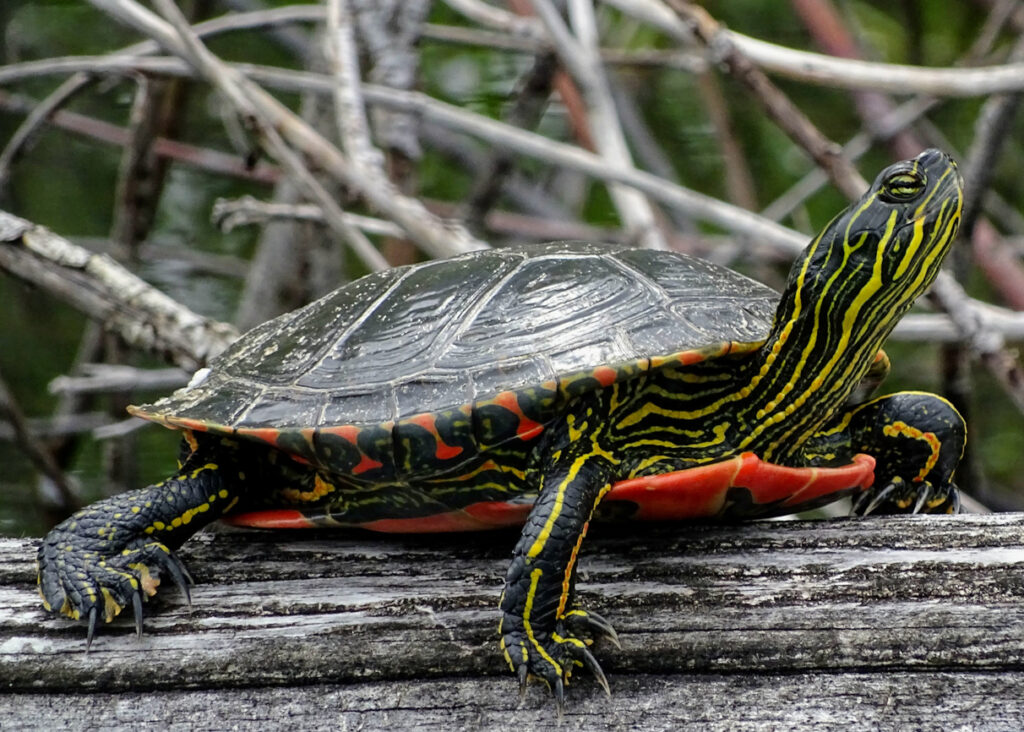 Photo by iStock
Unlike mammals that retreat into insulated dens, these turtles spend much of the winter submerged beneath the water, sometimes under thick ice, surviving for months without coming to the surface for air.
It’s an extraordinary adaptation for an animal more commonly associated with warm sunshine and lazy summer afternoons.
BC’s Colourful Freshwater Resident
The western painted turtle is British Columbia’s only remaining native freshwater turtle species. Despite its name, its upper shell, or carapace, is generally dark olive to black. The real colour appears underneath, where brilliant orange-red markings and intricate dark patterns decorate the lower shell, called the plastron. Yellow stripes along its head, neck and legs complete its distinctive appearance.
Adults can reach approximately 25 centimetres in shell length, with females generally growing larger than males.
In British Columbia, western painted turtles occur in two geographically distinct populations. The Intermountain–Rocky Mountain population inhabits the southern Interior, including the Okanagan, Thompson, Kootenay and Cariboo regions. The Pacific Coast population occupies scattered wetlands in the Lower Mainland, Sunshine Coast and parts of Vancouver Island.
The Interior population is federally listed as Special Concern, while the Pacific Coast population is listed as Threatened under Canada’s Species at Risk Act.
Both populations depend on freshwater wetlands with slow-moving water, soft substrates, aquatic vegetation and partially submerged logs or rocks for basking.
During spring and summer, western painted turtles are most easily observed warming themselves in the sunshine. Like other reptiles, they are ectothermic, meaning their body temperature depends heavily on their surroundings. Basking allows them to warm their bodies, improving their ability to move, digest food and carry out other essential functions.
But as autumn advances, those sunny opportunities become increasingly limited.
Preparing For The Long Winter
By October, western painted turtles are generally becoming less active as water temperatures decline. Feeding slows, movement decreases and individuals begin settling into their overwintering habitats.
Unlike warm-blooded animals, turtles cannot generate enough internal heat to maintain a constant body temperature. Instead, their metabolism slows dramatically as their environment cools.
This winter dormancy is often called hibernation, although the term brumation is commonly used for the seasonal inactivity of reptiles.
Research on coastal painted turtles in British Columbia suggests brumation can begin between late October and the end of November, when average water temperatures approach 9 C. Timing varies considerably depending on local conditions.
For Interior turtles, where lakes and ponds can remain frozen for months, choosing a suitable overwintering location is particularly important.
Most adults settle underwater in ponds, lakes, wetlands or slow-moving waterways, often resting on or near muddy bottoms. Areas containing submerged logs, woody debris or dense aquatic vegetation can provide important shelter.
Interestingly, the deepest water isn’t necessarily the best option. Research at Kikomun Creek Provincial Park in southeastern BC documented turtles overwintering in water just 10 to 100 centimetres deep, close to shore, where oxygen concentrations were higher than in deeper areas.
Once settled, the turtles enter an extended period of remarkable physiological conservation.
How Can Turtles Survive Without Breathing?
Perhaps the most astonishing feature of western painted turtle hibernation is their ability to survive underwater for months without taking a breath of air.
During summer, turtles breathe using lungs and must periodically surface. Winter presents a problem: when ponds freeze, access to the surface may become impossible.
Fortunately, western painted turtles possess several adaptations that allow them to endure these conditions.
As the water cools, their metabolic rate drops substantially. Their hearts beat more slowly, their bodies require considerably less energy and their oxygen demands decrease.
They can also absorb limited amounts of dissolved oxygen directly from the surrounding water through specialized tissues, including the lining of their throat, skin and cloacal region.
However, this oxygen uptake may not be sufficient during prolonged winter dormancy, particularly in oxygen-poor water.
That’s when their most extraordinary adaptation becomes essential.
Western painted turtles can survive extended periods through anaerobic metabolism, producing energy without oxygen.
There’s a catch: anaerobic metabolism produces lactic acid, which can accumulate to dangerous levels.
Painted turtles have evolved an unusual defence. Minerals in their shells and skeletons help buffer the accumulating acid, protecting their tissues from potentially lethal changes in acidity.
Scientific research has demonstrated that adult western painted turtles can survive exceptionally long periods without oxygen at temperatures near freezing. Their remarkable tolerance makes them important subjects for scientists studying how vertebrate tissues respond to oxygen deprivation.
Far from being completely shut down, these animals remain alive beneath the ice, operating on an extraordinarily reduced energy budget.
And they aren’t necessarily motionless throughout winter. Research at Burnaby Lake has documented some turtles moving between depths and locations during relatively mild winter conditions.
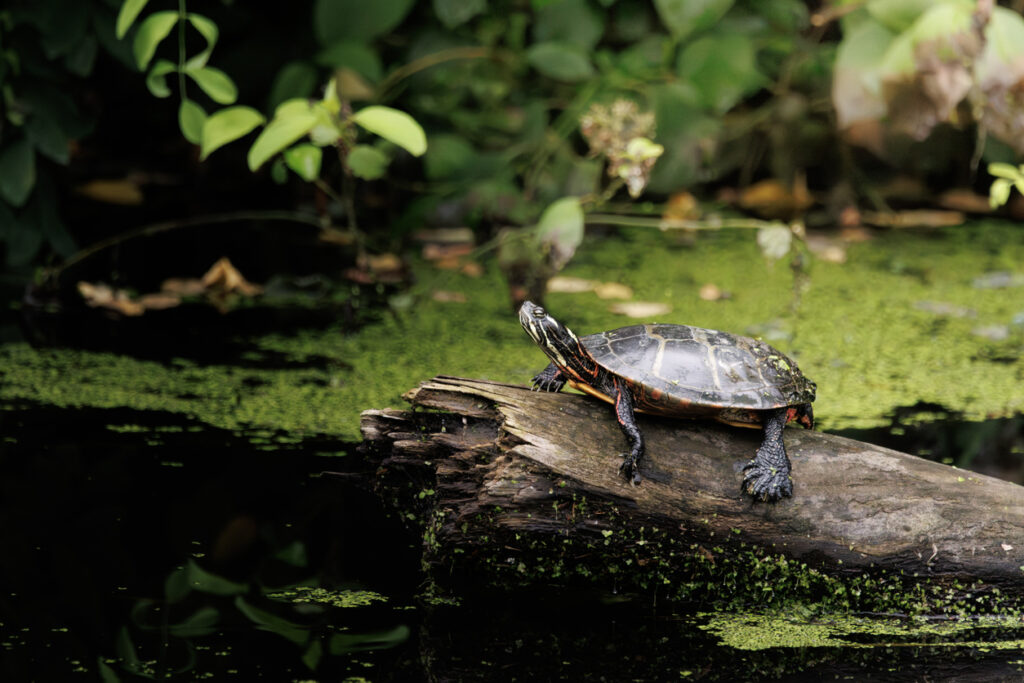 Photo by iStock
A Different Winter For Baby Turtles
For newly hatched western painted turtles, their first winter can involve an entirely different survival strategy.
Females typically lay eggs during late spring and summer, digging nests in sunny, well-drained soil, sand or gravel, often within 200 metres of water.
The eggs develop over summer, with nest temperature helping determine whether hatchlings become male or female.
Although many eggs hatch in late summer or early autumn, the young turtles often remain underground rather than immediately heading for the nearest pond.
Instead, they spend their first winter inside the nest chamber, sometimes only a few centimetres beneath the soil surface.
This exposes them to a different danger: freezing temperatures.
Hatchling painted turtles possess exceptional cold tolerance. Research has shown that they can sometimes survive partial freezing of their body fluids. They may also avoid freezing through a process called supercooling, in which their body fluids remain liquid below their normal freezing point.
Neither strategy guarantees survival, particularly during prolonged periods of extreme cold. Snow cover, soil conditions and winter temperature fluctuations can influence whether hatchlings emerge successfully the following spring.
Those that survive eventually dig their way to the surface and make their first journey toward water.
Protecting A Vulnerable Survivor
Despite their remarkable ability to endure harsh winters, western painted turtles face serious challenges in British Columbia.
Wetland destruction, shoreline development and road mortality threaten both populations. Females are particularly vulnerable when travelling overland to nesting areas.
Introduced red-eared sliders, frequently released from captivity, present another concern. These non-native turtles compete for food and basking habitat and may introduce diseases.
Conservation organizations are working to protect nesting sites, restore wetlands and improve survival rates. In some coastal locations, vulnerable eggs are collected and incubated under controlled conditions, while young turtles may be raised temporarily before being released into suitable habitat.
Protecting winter habitat is equally important. Wetlands must maintain suitable water depths, oxygen conditions and shelter throughout the coldest months.
For the public, helping painted turtles can be as simple as protecting wetland vegetation, keeping dogs away from nesting areas, never releasing pet turtles into the wild and observing basking turtles from a respectful distance.
As October gives way to November, western painted turtles will become increasingly difficult to find. The familiar sight of dark shells lined up along sun-warmed logs will disappear from many BC wetlands.
But beneath the cold water, these remarkable reptiles will remain, waiting out the winter through an astonishing combination of biological adaptations.
And when spring sunshine finally warms the ponds again, they’ll emerge to reclaim their favourite basking spots, continuing a seasonal cycle that has played out for thousands of years.