
In a pasture near Abbotsford, the first clue may be a fresh heap of soil. Beneath it, a broad-footed animal is moving through the dark, shouldering loose earth aside and probing the tunnel ahead with a sensitive snout. It may never break the surface. Most people living a few kilometres away will never see one.
Townsend’s mole is an animal of hidden superlatives. It is the largest mole in North America, and its Canadian distribution is confined to a small pocket of the central Fraser Valley near Abbotsford and Huntingdon, along the US border. In that narrow foothold, the species depends on a particular combination of deep, workable soil, abundant invertebrate prey and connected ground through which a young mole can disperse.
That makes this unfamiliar mammal one of BC’s most compelling conservation stories. Its habitat is not an alpine wilderness or an old-growth valley. It is a lived-in, worked landscape of pasture, lawns, roads, farms and expanding neighbourhoods. The mole’s future rests largely beneath places that look ordinary from above.
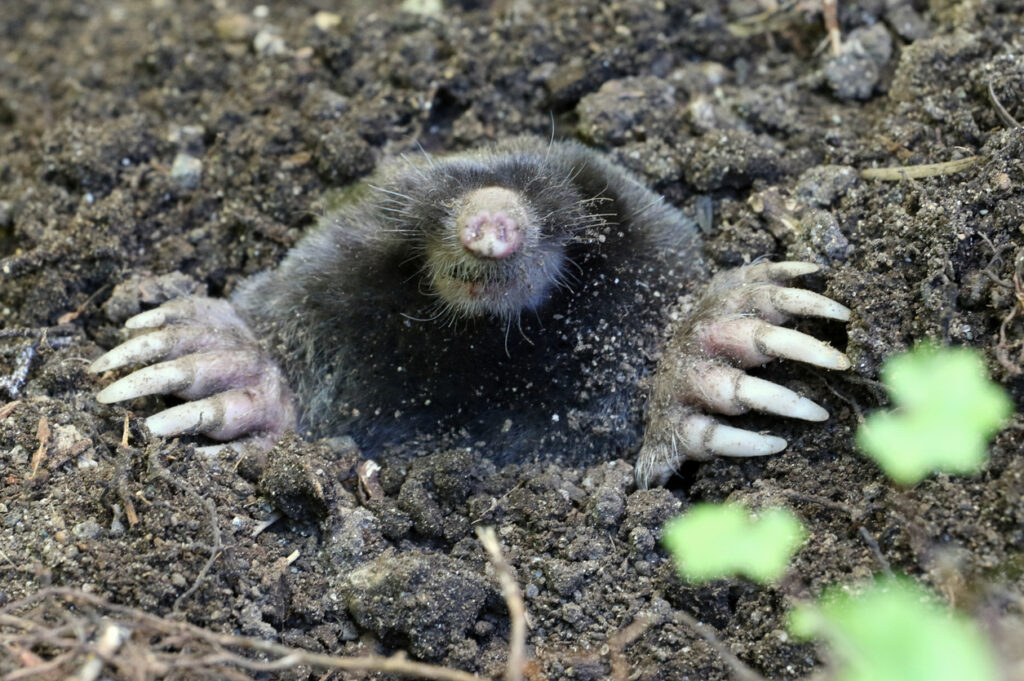 Photo by iStock
Built For A Buried Life
An adult Townsend’s mole is roughly 20 centimetres long. Males average about 138 grams and females about 114 grams, making both noticeably heftier than the coast mole, the other large mole found in southwestern BC Its fur is dense, velvety and usually blackish-brown to grey. Minute eyes register little more than changes in light, while external ears are absent. A short tail and long, almost bare snout complete an outline that seems streamlined for soil rather than air.
The front feet are the giveaway. They are broad, turned outward and armed with long, flat claws: living shovels powered by strong shoulders. As the mole digs, its compact body follows through a tunnel barely wider than itself. Shallow feeding runs usually lie five to 15 centimetres below the surface. More permanent passages can be deeper, and documented tunnels have carried moles one to three metres beneath roads, buildings and fence lines.
What looks like a random maze is a working system. Tunnels provide shelter, travel routes and a place to search for food. Townsend’s moles are generally solitary and territorial, although neighbouring tunnel systems can overlap. They patrol these underground corridors for earthworms, which made up 70 to 90 per cent of stomach contents in an Oregon study. Other soil invertebrates and small amounts of plant material round out the diet.
A Nose Made For Touch
For an animal that spends nearly its entire life underground, vision offers little help. Touch matters far more. Whiskers on the face and body detect contact with tunnel walls, while the snout samples whatever lies ahead. The effect is not unlike reading a room by brushing it with fingertips, except the mole does it while moving through complete darkness.
The snout is more than a nose. Microscopic domes called Eimer’s organs occur on the moist, bare pad at the tip. Researchers have identified these mechanosensory structures in Townsend’s mole and most of its mole relatives. Packed with nerve endings, they turn the snout into a tactile surface capable of detecting fine contact cues. It is a less flamboyant adaptation than the fleshy rays of the star-nosed mole, but it solves the same fundamental problem: how to gather detailed information where light is absent.
The comparison is useful because the two species are sometimes confused in popular accounts. The star-nosed mole does not occur in BC; its Canadian range is farther east. Townsend’s mole has a plain, elongated snout, yet the sensory equipment in that modest-looking tip is extraordinary in its own right.
A Canadian Foothold At The Border
Townsend’s mole ranges south through parts of Washington and Oregon, but in Canada it is known only from the Fraser Valley near the international boundary. The first documented BC specimens were collected at Huntingdon in 1927. Records from the 1930s and 1940s also came from the same general area, suggesting that the Canadian population has long been localized.
Why it stops there is largely a question of ground. In BC, records are closely associated with deep, moist silt-loam soils that are neither waterlogged nor prone to flooding. Pasture can suit the species well because grass cover supports soil life and leaves the ground open enough to tunnel. Lawns and golf courses can also provide habitat. Sandy, gravelly, compacted or saturated ground is a far poorer proposition for an animal that must dig for every meal.
Earthworms are another part of the puzzle. Federal recovery documents note the possibility that land clearing and introduced earthworms helped Townsend’s mole expand into Canada, but the idea remains uncertain. What is clear is that the species is restricted here by suitable soil and prey, and that its ability to move between habitat patches is limited.
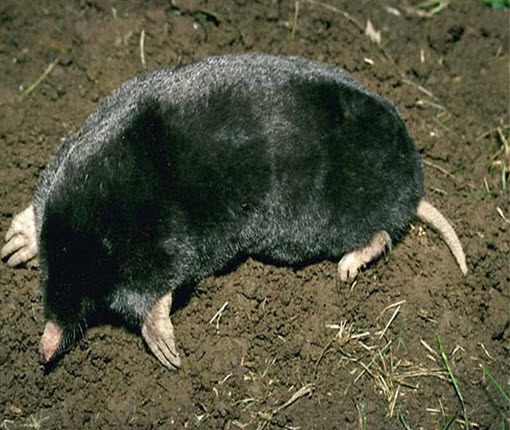 Photo by Canada.ca
Reading The Molehills
Seeing the animal is unlikely, but its earthworks can be conspicuous. A mound more than 15 centimetres high and about 40 centimetres across, paired with a tunnel wider than 4.5 centimetres, is more likely to have been made by a Townsend’s mole than a coast mole. Measurements are clues, not a field identification guarantee; the two species overlap in size, and a mound reveals only the excavator’s engineering.
The largest mound may hide a nursery. A female builds a chamber roughly 15 to 20 centimetres below ground and lines it with vegetation. Townsend’s moles produce one litter a year, usually one to four young, with three most common. The young are weaned after about a month and must eventually leave the maternal tunnel system.
Dispersal is a dangerous passage in any fragmented landscape. Studies cited in the federal recovery plan found that adults generally moved modest distances, while dispersing juveniles averaged about 165 metres and one travelled 800 metres. A road, greenhouse complex or strip of unsuitable soil can therefore be more than a line on a map. It can divide an underground world into pieces the next generation may not be able to bridge.
Life Below A Changing Landscape
The Committee on the Status of Endangered Wildlife in Canada first assessed Townsend’s mole as threatened in 1996 and raised the designation to endangered in 2003, confirming it again in 2014. The BC Conservation Data Centre ranks it S1, or critically imperiled in the province. A federal recovery strategy published in 2016 cited an estimate of 420 to 490 mature animals, but that figure came from earlier habitat-based calculations, not a recent head count. The population trend remains unknown.
Uncertainty does not make the threats obscure. Converting pasture to housing, roads, intensive berry production or greenhouses can remove or fragment habitat. Plowing and other soil disturbance can collapse shallow tunnels or destroy nests. Traps and other forms of mole control are especially concerning because Townsend’s and coast moles can be difficult to distinguish without close examination.
The answer is not to freeze the Fraser Valley in place. It is to recognize that working lands can also be wildlife habitat, and to keep suitable soil connected wherever possible. Landowners in the species’ known range can seek current provincial guidance before controlling moles and can report suspected sightings or unusual mole activity to conservation authorities. Planners and land managers can factor soil type and underground connectivity into decisions that would otherwise consider only what is visible at the surface.
Townsend’s mole is easy to overlook precisely because it asks us to imagine a landscape from below. To the mole, a pasture is a ceiling over a hunting ground, a ditch can be a barrier and a patch of deep silt loam can be an entire world. Its remarkable snout reads that world one touch at a time. Whether it continues to do so in Canada will depend on how carefully we read the ground above it.