
The forest may appear to offer slim pickings in the middle of winter. Berries have long since dropped, mushrooms are hidden beneath snow or frozen ground and spring greens are still months away. Yet overhead, one of British Columbia’s most abundant wild seasonings remains green.
Douglas-fir needles can be gathered throughout the year. Their flavour shifts with the seasons, from the soft, citrusy taste of new spring growth to the deeper, more resinous character of mature winter needles. A few carefully clipped sprigs can be steeped into tea, infused into sugar or salt, stirred into syrup or used to add a distinctly West Coast note to wild-game dishes.
The key is knowing exactly what to gather – and taking so little that the tree never shows you were there.
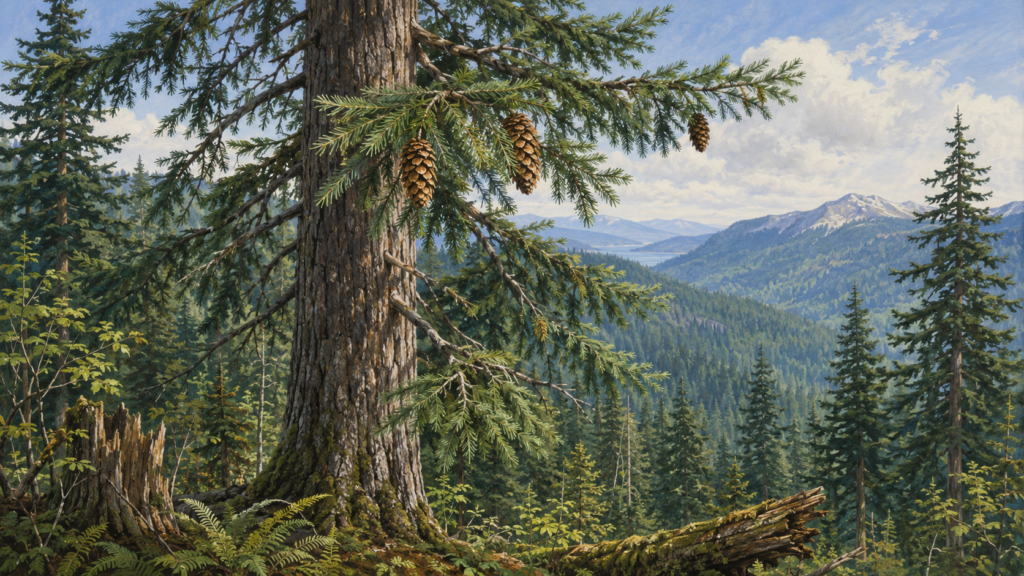 Illustration created using OpenAI
A Familiar Tree With An Unfamiliar Use
Douglas-fir, Pseudotsuga menziesii, is one of the defining trees of British Columbia’s forests. Despite its name, it is not a true fir, which is why the common name is properly written with a hyphen.
British Columbia is home to two recognized varieties. Coastal Douglas-fir, Pseudotsuga menziesii var. menziesii, grows on Vancouver Island and along the southern coast, where favourable conditions allow it to reach immense proportions. Interior Douglas-fir, var. glauca, is generally smaller, more cold tolerant and adapted to the drier forests of the southern and central Interior.
Together, the two varieties give Douglas-fir an extensive provincial range. Depending on where you live, it may grow alongside western redcedar and western hemlock, ponderosa pine and trembling aspen, or lodgepole pine, spruce and western larch.
Its culinary use is less widely known, but it is not new. Ethnobotanical accounts from the Pacific Northwest document the use of Douglas-fir twigs and needles in beverage teas. Today, foragers and chefs prize the foliage for a flavour often described as citrusy, zesty and resinous, with notes that may suggest lemon peel, grapefruit or a walk through the forest after rain.
How To Identify Douglas-Fir
Never identify a wild food by smell alone. Before collecting Douglas-fir needles, use several physical features to confirm the species.
The tree’s best field mark is its cone. Douglas-fir cones hang down from the branches and have distinctive three-pointed bracts protruding between their scales. They are often described as resembling the back legs and tail of a mouse hiding inside each cone.
Look beneath a mature tree for fallen cones. Even when none remain on the branches, intact cones on the ground can help confirm the identity of the tree above.
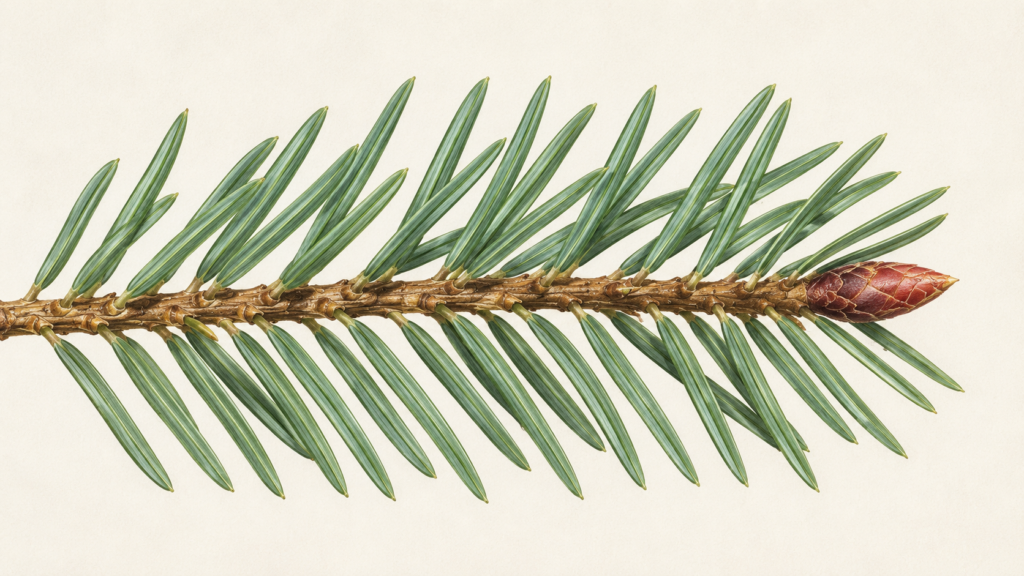
The needles provide additional clues. They are:
- Flat, flexible and relatively soft to the touch
- Usually two to three centimetres long
- Attached individually to the twig by short, narrow stalks
- Arranged spirally, although they may appear to spread from two or three sides of the branch
- Grooved along the upper surface, with pale lines underneath
When crushed, the needles may release a mild fruity or apple-like fragrance. The buds are another useful feature: narrow, sharply pointed and covered with shiny reddish-brown scales. On older trees, the bark becomes thick, dark and deeply furrowed.
Do not rely on bark alone, especially when identifying young trees. Always confirm the needles, buds and, whenever possible, the cones.
Watch Out For Pacific Yew
The most important safety rule is to distinguish Douglas-fir from Pacific yew, Taxus brevifolia.
Pacific yew is a native evergreen that may grow beneath Douglas-fir, western redcedar and western hemlock. Its flat needles can appear similar to those of Douglas-fir, particularly to someone unfamiliar with conifers. Yew foliage contains potent toxins that can cause severe and potentially fatal heart problems.
Unlike Douglas-fir, Pacific yew does not produce woody cones. Female yews bear single seeds partly enclosed in bright red, berry-like structures. Yew needles generally lie in flatter rows along the twig, and the tree or shrub often has thin, scaly, reddish-purple bark rather than the deeply furrowed bark of a mature Douglas-fir.
Do not taste a conifer until its identity is certain. If the tree has no recognizable Douglas-fir cones nearby, confirm it with a reliable regional field guide or an experienced botanist before harvesting.
 Douglas-fir needles.
Illustration created using OpenAI
The Spring Harvest
The most anticipated Douglas-fir harvest arrives when the tree’s pointed buds open and release tufts of brilliant green new growth. The timing varies with latitude, elevation and local weather, but the window generally falls sometime during spring.
New tips are easy to distinguish from the previous year’s dark-green foliage. At first, the needles are tightly clustered and exceptionally tender. As the shoot lengthens, the needles spread away from the developing stem, gradually darkening and becoming tougher.
This young growth usually has the tree’s mildest and brightest flavour. Depending on the individual tree, it can taste lemony, fruity, lightly resinous or occasionally bitter. Sample a single correctly identified tip before gathering more; flavour can vary noticeably from one tree to another.
Tender tips can be finely chopped and added to sugar, salt, shortbread, sauces or marinades. They can also be steeped in hot water, infused into honey or vinegar, or frozen for later use.
The soft-tip stage is brief. Once the needles reach full size and the new stem begins to toughen, they are better treated as an aromatic herb than eaten directly.
Harvesting Without Harming The Tree
Every spring tip is new branch growth. Removing one does not simply pick a leaf; it changes the way that portion of the branch develops.
Never collect the upright leader at the top of a young tree. Damaging the leader may distort the tree’s growth or cause it to form multiple tops. Avoid stripping all the tips from a single branch for the same reason.
Instead, gather a few side tips from several healthy, established trees. Move around the tree, clipping scattered shoots so the harvest is visually undetectable. A small handful is enough for most home recipes, and strong conifer flavours rarely benefit from excess.
Use clean scissors or pruners rather than tearing the new growth. Do not harvest from seedlings, stressed trees or branches showing discoloured foliage, heavy insect damage or disease.
When gathering mature needles later in the year, clip a few small side sprigs rather than removing entire branches. Douglas-fir needles can remain on the tree for five to eight years, making them available in every season, but they still perform essential work for the tree.
A Year-Round Wild Seasoning
Spring tips receive most of the attention, but mature Douglas-fir needles are useful long after the new growth has hardened.
Summer needles tend to be more robust and resinous than spring tips. In autumn, cooling temperatures can make a warm Douglas-fir infusion particularly appealing. Winter needles remain fragrant beneath rain or snow, providing a wild ingredient at a time when little else is available.
Mature needles are usually too tough to eat whole. Instead, separate them from the woody twig, chop them and use them to infuse liquids. Hot water, cream, syrup, vinegar and alcohol can all capture their aroma. The stronger flavour works especially well in small quantities alongside rich meats.
Taste the needles before committing them to a dish. Trees growing only a short distance apart may differ in sweetness, bitterness and resin intensity. What tastes pleasantly citrusy on one tree may be overwhelmingly turpentine-like on another.
Cleaning & Storing The Harvest
Collect only clean, healthy foliage. Avoid trees growing directly beside busy roads, industrial areas or places where herbicides and pesticides may have been applied. Do not gather from ornamental plantings unless you know the tree has not been chemically treated and you have permission from the owner.
Shake the sprigs outdoors to dislodge insects and loose debris. Rinse them in cool water and dry thoroughly on a clean towel.
Fresh spring tips can be stored in the refrigerator for several days in a loosely closed container with a slightly damp paper towel. For longer storage, spread them on a tray, freeze them and then transfer them to a freezer bag or container.
Mature needles can also be dried. Strip them from the twigs and spread them in a thin layer in a warm, airy place away from direct sunlight. Once completely dry, store them in an airtight jar. Their fragrance will fade over time, so small, frequently replenished batches are better than a year’s supply gathered at once.
 Illustration created using OpenAI
From Forest To Kitchen
The simplest introduction to Douglas-fir is tea. Finely chop approximately one teaspoon of fresh needles, place them in a cup and cover them with hot water. Allow the mixture to steep for five to 10 minutes, then strain. Add honey if desired.
Start with a weak infusion. Mature needles can become bitter when too much is used or when they are steeped for too long.
For cooking, think of Douglas-fir as a strong aromatic rather than a vegetable. It pairs naturally with ingredients that balance its resinous edge:
- Honey or maple syrup
- Lemon, orange and tart berries
- Garlic and black pepper
- Juniper
- Mustard
- Smoked salt
- Rich meats
To make Douglas-fir finishing salt, finely chop a small spoonful of clean spring tips and combine them with about half a cup of coarse salt. Spread the mixture on a plate and allow it to dry completely before transferring it to a jar. Sprinkle it sparingly over grilled venison, roast duck, fish or campfire potatoes.
For a simple game glaze, steep chopped needles in warm honey, then strain and combine the infused honey with mustard, cider vinegar and a pinch of salt. Brush it onto duck or venison near the end of cooking so the sugars do not burn.
The needles can also flavour simple syrup for sparkling water or cocktails, but use a light hand. The goal is to capture the suggestion of the forest, not make the drink taste like a Christmas tree.
Know Where You Are Gathering
Finding a Douglas-fir does not automatically mean you are allowed to clip it.
Removing natural material from a BC Park is usually illegal. BC Parks directs visitors not to remove berries, mushrooms, flowers, wood or other natural objects unless they hold specific authorization or are exercising applicable Indigenous harvesting rights.
Permission is required on private property. Other public and Crown lands may be subject to tenures, local rules, conservation designations or restrictions, so check the status of the land before gathering. Collect only for personal use unless you have confirmed the requirements for commercial harvesting.
Responsible harvesting also means recognizing that Indigenous Peoples have gathered and managed plants in these territories since long before recreational foraging became popular. Avoid heavily used cultural gathering areas, respect closures and never interfere with another person’s harvest.
A Taste Of The Season
Douglas-fir may be available throughout the year, but it never tastes quite the same twice.
In spring, the tree offers tender green tips with a fleeting citrus brightness. By summer, the flavour has deepened. Autumn needles bring a sharper forest aroma, while winter foliage produces a strong, warming infusion gathered when the rest of the landscape appears dormant.
That seasonality is part of the appeal. Harvesting Douglas-fir is not about filling bags or stocking shelves. It is about learning one tree well enough to recognize its changes: the pointed buds before they open, the luminous flush of new growth, the hanging cones and the fragrance released by a few needles crushed between the fingers.
Gather lightly, identify carefully and take only what the kitchen requires. The best wild harvest is often the one that leaves no visible trace behind.