
In the damp shade of British Columbia’s forests and along coastal trails, one of spring’s most accessible wild edibles quietly carpets the ground. Claytonia perfoliate, better known as miner’s lettuce, is a succulent, vitamin-rich green that has nourished people for centuries, from Indigenous communities to Gold Rush prospectors. Today, it remains one of the easiest and most rewarding plants for beginner foragers to identify and enjoy.
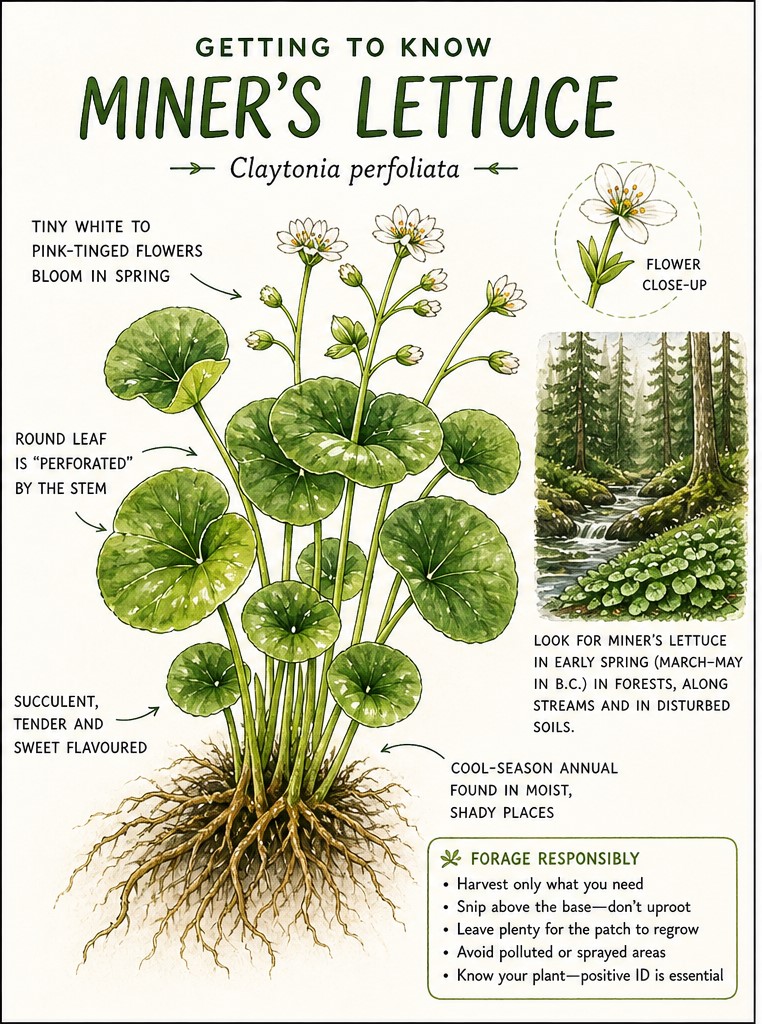 Illustration by OpenAI
A West Coast Native Worth Knowing
Miner’s lettuce is native to western North America, including British Columbia, where it thrives in moist, shaded environments such as forest openings, stream edges and disturbed soils.
The plant is instantly recognizable: delicate stems rise through a distinctive round leaf that appears pierced in the centre, topped with tiny white or pink-tinged flowers. Its low-growing habit and tendency to form dense patches make it an ideal forage species for those just learning to identify wild foods.
Closely related species in the genus Claytonia occur across the province, but C. perfoliata is the most commonly harvested and widely recognized edible.
When & Where to Find It
In British Columbia, miner’s lettuce emerges in early spring, often as early as March in coastal regions, and is typically at its peak through April and May.
It favours:
- Moist, well-drained soils
- Partial shade to full shade
- Forest edges, parks and disturbed ground
Because it is a cool-season annual, the plant thrives in spring’s mild temperatures and often fades or flowers out as summer heat arrives.
Foragers will often find it in abundance after winter rains, sometimes forming lush green carpets beneath trees or along trails.
A Gold Rush Superfood
The name “miner’s lettuce” dates back to the mid-1800s, when California Gold Rush miners relied on the plant as a vital source of vitamin C to prevent scurvy.
Long before that, Indigenous peoples across the West Coast harvested the plant as part of a seasonal diet rich in wild greens. While documentation varies by region, miner’s lettuce was traditionally valued for both its nutritional content and its availability at a time of year when fresh foods were scarce.
This blend of cultural and practical history has cemented miner’s lettuce as one of North America’s most iconic wild edibles.
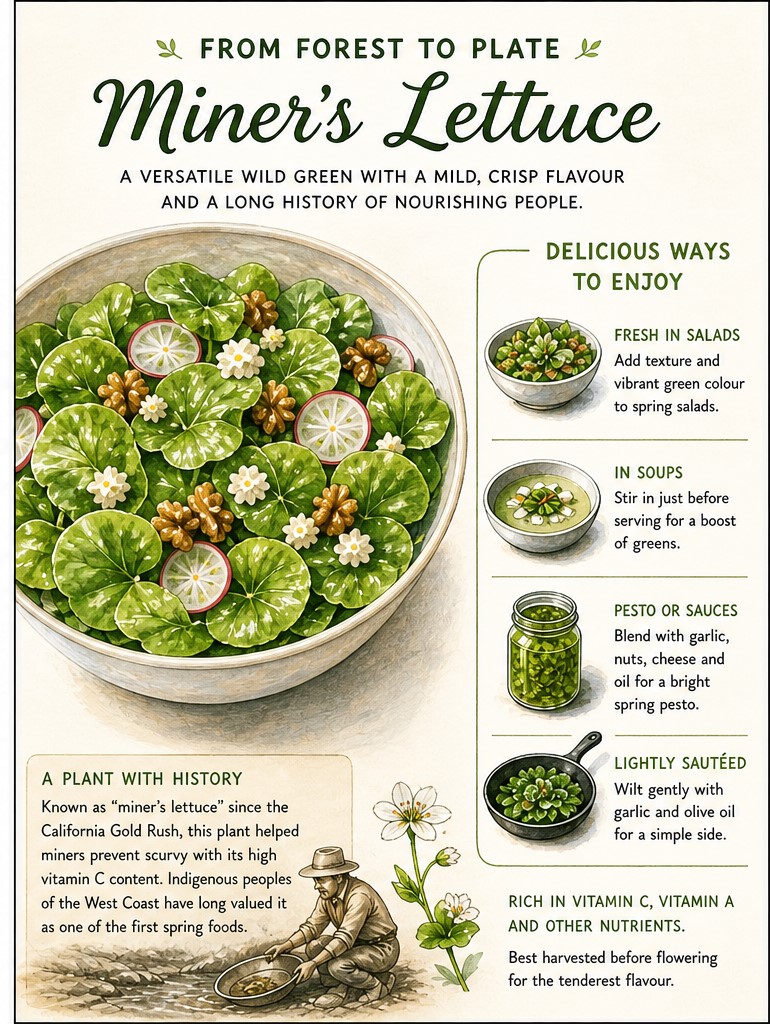 Illustration by OpenAI
How to Harvest Responsibly
Miner’s lettuce is considered a beginner-friendly forage, but responsible harvesting is still essential:
- Harvest young leaves and tender stems before flowering for best flavour
- Snip above the base to allow regrowth – plants can produce multiple flushes
- Avoid uprooting the plant
- Never harvest from contaminated areas (roadsides, industrial zones)
- Take only what you need, leaving plenty behind
As with any wild plant, proper identification is critical before consumption.
From Forest Floor To Plate
Miner’s lettuce has a mild, slightly sweet flavour with a crisp, succulent texture—often compared to spinach or mild lettuce. Its versatility makes it a favourite among chefs and home cooks alike.
Common uses include:
- Fresh in salads (the most popular preparation)
- As a garnish for spring dishes
- Lightly sautéed or added to soups
- Blended into pesto or green sauces
The entire above-ground portion of the plant is edible, and it is notably rich in vitamins, particularly vitamin C.
Because of its delicate texture, many foragers prefer to eat it raw to preserve its crispness and subtle flavour.
A Seasonal Signal
Beyond its culinary appeal, miner’s lettuce is a signal of the changing seasons. Its appearance marks the transition from winter scarcity to spring abundance – a reminder that some of the most nourishing foods are growing quietly underfoot.
For British Columbia foragers, it offers a simple entry point into wild harvesting: easy to identify, plentiful, and deeply rooted in the region’s natural and cultural history.