
On a still morning in Haida Gwaii, the forest can feel almost soundproof – cedar columns, hemlock shade, and a floor stitched together with moss and nurse logs. Then a clear, flute-like whistle drops through the canopy, pauses, and returns on the same pitch, as if someone is testing a single note in a vast green cathedral. That spare, haunting refrain is one of the most recognizable signatures of the Varied Thrush, a bird that is both common in coastal rainforests and famously hard to actually see.
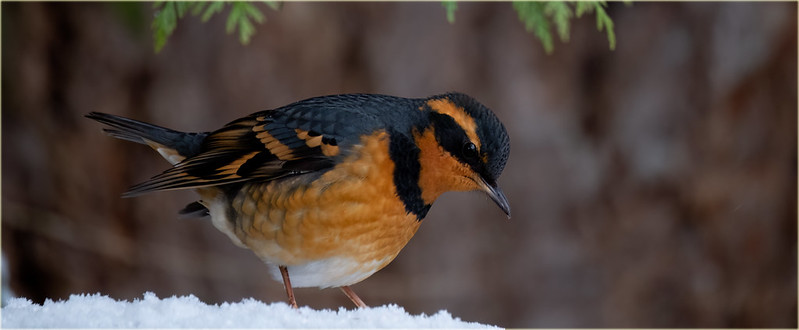 Photo by marneejill Flickr
A Rainforest Thrush With Island Roots
The Varied Thrush (Ixoreus naevius) is closely tied to the Pacific Northwest’s damp, mature forests – especially places dominated by Sitka spruce, western hemlock, and western redcedar. Those are the same tree species that define much of Haida Gwaii’s low-elevation rainforest, including in Gwaii Haanas, where Parks Canada describes dense, mossy forests nurtured by frequent rain and moderate temperatures.
On the provincial map, Varied Thrush is a “cool forest” bird – widespread in B.C.’s wetter coastal and mountain forests and largely absent from the province’s drier interior plateaus. In other words: Haida Gwaii is prime territory. Here, the species is not just a visitor passing through. Naturalists and birders regularly encounter it year-round in forest edges, second growth stands with dense cover, and older forests where the understory still has complexity.
The Haida Gwaii Varied Thrush
Island isolation has a way of nudging wildlife onto its own path. Haida Gwaii is well known for distinctive local forms – subspecies and populations shaped by geography, climate, and deep time. Among them is the “Haida Gwaii Varied Thrush,” commonly described as a local subspecies (Ixoreus naevius carlottae) found only on the archipelago.
Taxonomy can be a moving target – ornithologists sometimes revise subspecies boundaries as new measurements and genetic work accumulate. But from a conservation and storytelling perspective, the key point remains: Haida Gwaii’s Varied Thrush population is part of a broader pattern of island distinctiveness, and it’s one more reason birders treat the archipelago as more than “just another coastal hotspot.”
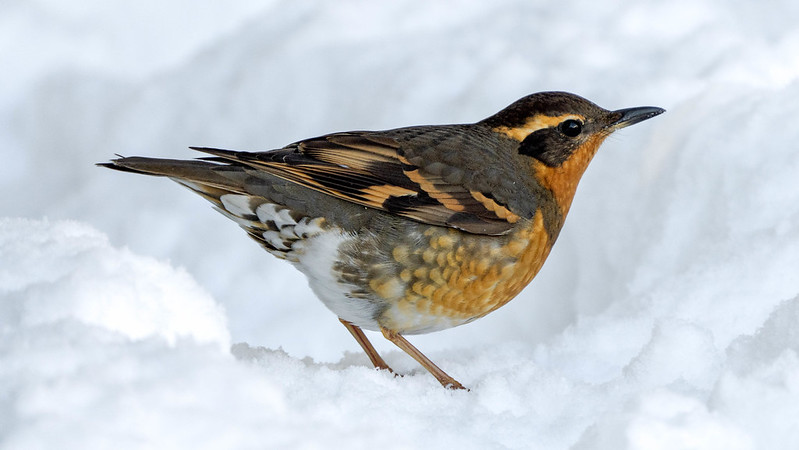 Photo by marneejill Flickr
Why You Hear It Before You See It
Varied Thrushes are robin-sized and stocky, but their behavior is different from the familiar lawn-foraging American Robin. They keep to cover, often feeding on the ground along shadowed trails or in the understory, then rocketing into the mid-canopy at the first hint of movement.
Their diet changes with the seasons. In breeding months, they take insects and other invertebrates gleaned from leaf litter and low vegetation; in winter and during migration they broaden the menu to include fruits and berries, which can pull them into riparian thickets, parks, and even gardens when food is abundant. In Haida Gwaii’s wet coastal climate – where berries, fallen fruit, and forest-floor invertebrates can be available across a long shoulder season – this flexibility helps explain how the species persists through stormy months when other songbirds thin out.
Old Forests, Understories & A Quiet Conservation Warning
Across Canada, the Varied Thrush is still widely distributed, but federal status information flags a concern: Breeding Bird Survey data indicate a moderate national decrease since the early 1970s, and the species is identified as a priority for conservation or stewardship in at least some regions.
On Haida Gwaii, one of the most visible ecological pressures isn’t a single logging plan or one bad storm season – it’s what happens when the understory disappears. Sitka black-tailed deer were introduced to Haida Gwaii in the late 1800s and spread across many islands over the following decades. In Gwaii Haanas, Parks Canada notes that deer browse through forest understory and even intertidal zones, impacting culturally important plants and altering ecosystems.
Researchers have documented that long-term deer browsing can dramatically simplify understory vegetation and, in turn, reshape bird communities – particularly reducing species that depend on dense understory structure for nesting and feeding. That matters for a bird like the Varied Thrush, which is closely associated with mature, humid forests and uses understory cover for foraging and concealment. The takeaway isn’t that the Varied Thrush is “doomed” on Haida Gwaii – it’s that the bird is a useful indicator. When the forest floor is rich with ferns, shrubs, and berry-producing plants, Varied Thrush habitat quality is usually high. When the understory becomes a bare, browsed hallway between tree trunks, the song can fade.
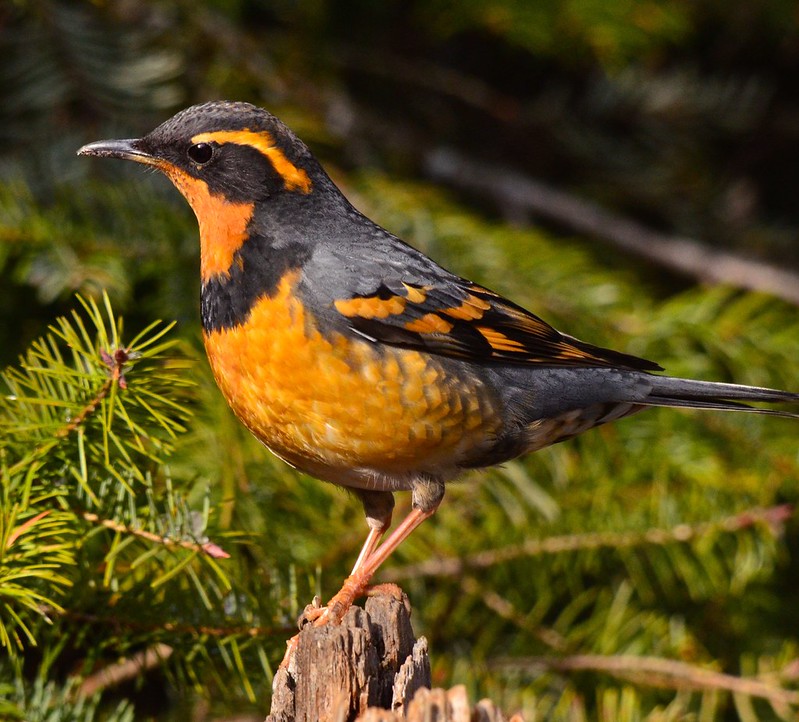 Photo by Eugene Beckes Flickr
Seeing (& Hearing) One On Haida Gwaii
If you’re looking for the Varied Thrush on Haida Gwaii, think like the bird: dim light, wet ground, and edge habitat where forest meets openings. Early morning after rain can be ideal – sound carries, and the bird may sing from mid-level perches before retreating to cover. And if you catch a flash of orange-and-slate slipping between salal and moss, that’s often the full encounter: a quick, vivid reminder that in Haida Gwaii, the rainforest doesn’t just host wildlife – it hides it, beautifully.